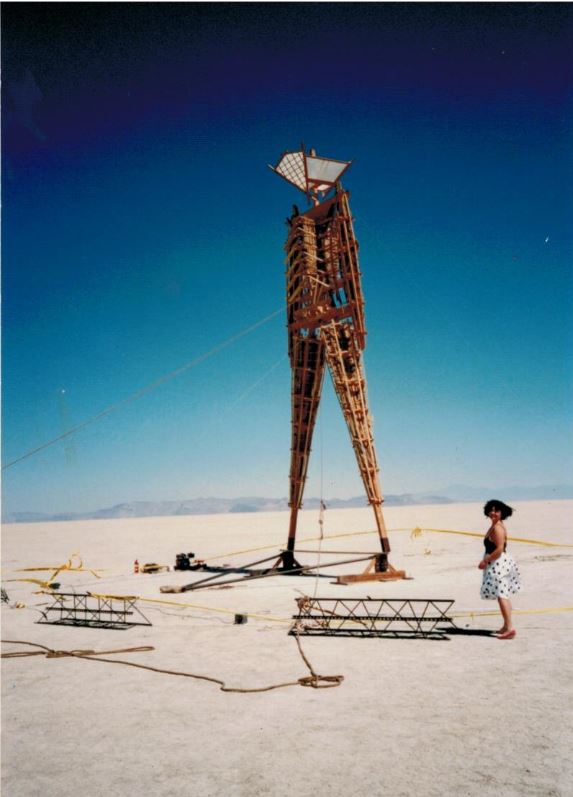
I’ve made a lot of things happen since I got out of college. This was one of them.
⚝──⭒─⭑─⭒──⚝
P Segal: Services to Community
I was born and raised in the Italian community of San Francisco (real name Roberta Pizzimenti). Ever since I returned from my college years in Los Angeles, I’ve served this city, its people, the arts community, and its businesses in many significant ways. Not the least of these is recording the city’s cultural history. This is a list of some of them.
- In 1981, right after my college years in Los Angeles, I found an investor and tried to buy the original Old Spaghetti Factory, an iconic piece of SF Beat history, when it was for sale. I lost it because I was advised to not buy it but just take the lease. I did that and found that not buying it would cost $440K to bring it up to code. I kept the historic Flamencos de la Bodega part of the Spaghetti Factory open for 7 months.
- While in LA, I became the publicist for an unknown band called Oingo Boingo. When I returned to San Francisco, I brought Danny Elfman and his band dinner after every show they played here.
- Attenzione, the magazine for and about Italian Americans, called my North Beach flat one of the three cultural hotspots of North Beach.
- In 1984, I got an owner move-in eviction from my flat and couldn’t find a single vacancy in North Beach. I moved to a 4800 square foot, 2-story flat in the Western Addition with 4 artist friends. That place became the unofficial clubhouse of the Cacophony Society, where we planned dozens of events.
- When the Burning Man event was stopped at Baker Beach in 1990, I suggested we take the event to the Black Rock Desert, where I’d been to an art event the year before, and facilitated planning for it. That flat was where all the planning for Burning Man took place for nearly a decade.
- One of the Cacophony events I organized got 40 people to read Proust together. Two of those people were engineers who designed the World Wide Web. The zine I produced about the Marcel Proust Support Group became the first serial publication on the Web, read by a quarter of a million readers a month for years. It was credited with launching the international Proust revival. It paid me nothing. (proustsaidthat.blog/zines).
- At our flat, 1907 Golden Gate, I introduced the designers of the World Wide Web to the artists they would train to launch the new field of computer graphics.
- In 1995, I opened the Center Camp Cafe at Burning Man and ran it for five years.
- In 1999, I opened the restaurant, Caffè Proust, with a very slim budget. In 2001, I applied for an SBA loan, and when the director heard what we opened with, she refused to give us what we asked for and insisted upon giving us twice that. Unfortunately, while we waited for the check, 9/11 decimated local business, and we never got the money.
- The SBA credited Caffè Proust with revitalizing the Divisadero corridor and turning an obscure corner of the inner city into NOPA.
- In 2006, I went to graduate school and got a master’s in psychology. For the three years of my internship, I counseled immigrant children in lower income neighborhoods.
- In 2009, I had a private practice with an office in the Flood Building. My clientele was mostly people in the arts.
- By the 20-teens, almost all my artist friends had left San Francisco, and I wanted to do something about it. At the end of 2015, I filed for nonprofit status under the name Bohemia Redux.
- In the early ‘teens, I wrote a column for the popular website, Broke Ass Stuart, called “The City That Was,” telling stories about what San Francisco was like before it became gentrified. Stuart was the last new roommate at 1907 Golden Gate before we got my second owner move-in eviction.
- In 2015, I got an invitation and a ticket to visit the Dream Community in Taiwan. Real estate developer Gordon Tsai built an apartment complex, where three buildings were residential condos and the fourth building was for international artists’ residencies, supported by a condo fee. Gordon consulted on ways to implement artists’ housing in San Francisco.
- In 2016, the National Endowment for the Arts enthusiastically offered to fund my project for artists’ housing and venues, if the city would work with us. I wrote letters and emails to Mayor Ed Lee, called his office repeatedly, showed up at City Hall and tried to get a chance to speak to the mayor. The city was only interested in tech companies. Mayor London Breed also was not interested in discussing artists’ housing.
- From 2017-18, I served on the Civil Grand Jury. I organized a committee to investigate the legalization of in-law apartments and wrote the report that showed why it was a good idea, including practical suggestions for how to expedite the permitting process.
- The Civil Grand Jury report went to the Board of Supervisors and legislation was passed to legalize in-law apartments. The city agreed that expediting permitting was a good idea that they would implement when their new office building was completed.
- In 2018, I spoke at The Battery about why we need artists’ housing. After I spoke, someone came up to me and said, “That’s a great idea!” Our conversation was interrupted, and I didn’t learn until this year that the person who approached me is the founder of SFJazz, who is tearing down the McKrosky Mattress Factory building to build an enormous building that will mostly house arts organizations and some artists.
- In 2019, we decided to close Bohemia Redux and seek fiscal sponsorship. We signed a contract with the venerable Intersection for the Arts, where we continue to be a client. We’re now ArtHouse (arthousesf.org).
- The pandemic lockdown put most people in the arts out of work for a long time, and there is no unemployment for the gig economy. During this period I got grants from The Author’s Guild, The Authors League, and PEN America. The grants were for a book of memoirs that is about my own life, but also a history of San Francisco’s underground creative culture during the latter half of the 20th century.
- In 2022, I joined the board of the Westside Observer, a 40-year-old neighborhood newspaper serving the city’s west side, which exposed malfeasance at Laguna Honda Hospital and won a prestigious award for it. I am currently getting them approved for fiscal sponsorship so I can write grants to keep them operating.
- Also in 2022, I spoke with Kate Sofis, director of OEWD, who called my plan for revitalizing the Financial District “awesome.” However, the OEWD would not discuss support for making it happen.
- In 2023, I was approached by a Cacophony friend and two North Beach filmmakers, who together organized a renegade neighborhood film festival, Films with Friends, that shows films in multiple stores, galleries, and bars one night a month. I got them fiscal sponsorship in 2024.
- In 2024, I spoke at Manny’s and the Commonwealth Club about why artists are an under-utilized asset.
- Also in 2024, I met with the west coast executive of the real estate conglomerate that owns the historic Hotel Whitcomb, which was the interim City Hall after the 1906 earthquake, and provided a proposal for turning it into artists’ housing and venues. The board, I’m told, liked my proposal, but rejected it because I could not provide capital.
- Also in 2024, a board member of the Mid-Market Business Association asked me to provide a proposal to convert any property in Mid-Market into artists’ housing, but they did not find a building owner interested in partnership.
- In 2025, I developed a proposal for people in the real estate industry, who are coping with a flat market, that outlines how realtors can collaborate with ArtHouse to find property owners open to 3-way partnerships. In this scenario, the building owner gets the bulk of rents and a percentage of income from ArtHouse businesses; the realtor who has brokered the deal gets a percentage, rather than a one-time commission, for the life of the project.
- The first discussion with a veteran realtor was met with enthusiasm, and he asked me to join the Economic Roundtable, a group of local business people who meet weekly to discuss economic trends and development.
This is a very incomplete list of things I’ve done since the college years. Perhaps one of my most meaningful contributions to my community was providing frequent and memorable social events that brought people together, where new alliances were formed, projects began, and people met in a joyous environment of creative invention. Recreating that space is a major incentive behind the ArtHouse project.
You can read about the ArtHouse project here: https://arthousesf.org
To contact me: psegal@arthousesf.org
Some articles about me and interviews:
https://www.sfgate.com/restaurants/article/Proust-Addicts-Find-Fix-2719948.php
https://www.sfgate.com/food/article/where-artists-and-others-can-dig-proust-3074513.php
https://brokeassstuart.com/sf/author/psegal/
https://www.trippingly.net/burning-man-musings/p-segal
https://westsideobserver.com/24/7-artists-housing-to-revitalizing-san-francisco.php
https://www.commonwealthclub.org/events/2024-09-23/revitalizing-sf-through-arts-what-does-look
https://sfstandard.com/2023/05/22/san-franciscos-downtown-doom-loop-may-have-a-silver-lining/
⚝──⭒─⭑─⭒──⚝
Ordinarily, I’d end a post with a quote from Proust relevant to the subject I wrote about. However, Proust died years before I was born, so he had nothing to say about me, but he did die on my birthday.

 Proust Said That ©