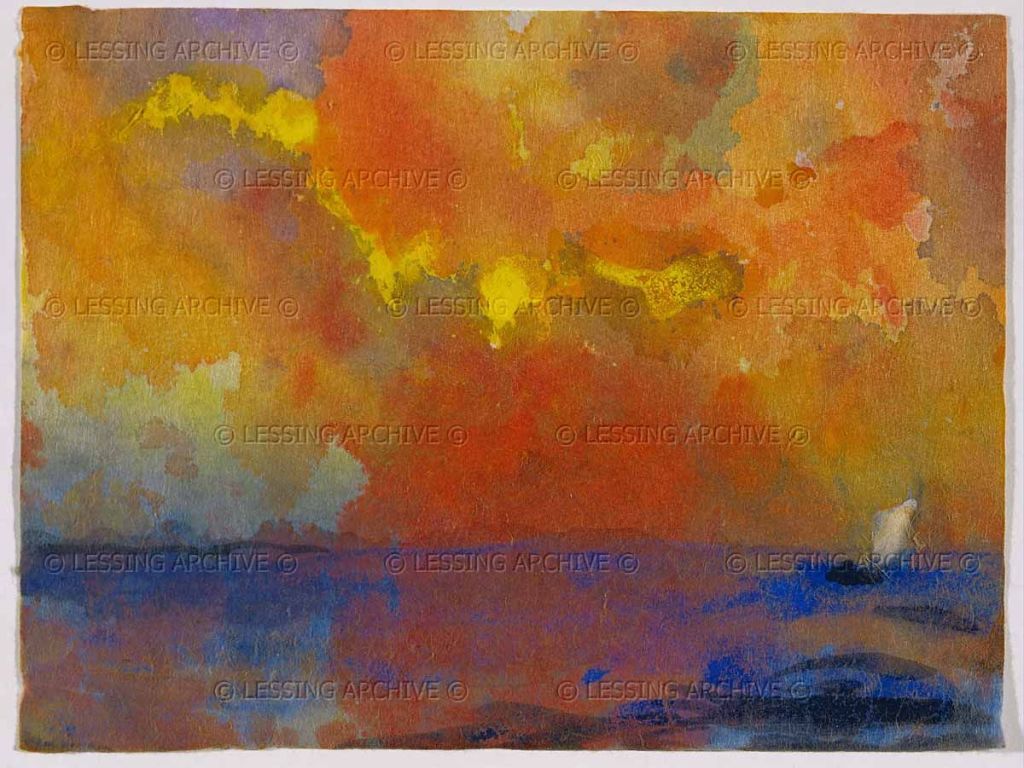
The last time I wrote about this, I also included a painting by the German Expressionist Emil Nolde because he scared the Nazis so much they took his paint brushes. More about Nolde later.
༻﹡﹡﹡﹡﹡﹡﹡༺
For almost a decade, I’ve been the lone voice in America speaking out in defense of artists, who are less honored in this country than anywhere else on earth. I’ve presented academic evidence that artists improve the mental health of cities, and that regular exposure to art increases lifespans. I have made the case that every neighborhood in San Francisco that got gentrified in the last 75 years was formerly a run-down area that artists made famous. I’ve explained how the presence of creative work was good for business and should be a factor in urban planning, in an article in the country’s oldest publication for planners. Has there been real support for the ArtHouse effort to restore the arts community in San Francisco, where a major global art movement launched almost every decade of the last century, and only a tiny fraction of that community remains? No. But now I’m going to make one last case that has never been more relevant: we need artists in our cities because fascists are afraid of us.
Fascists have always feared creative people because they inspire change, and it’s something they can’t control. The Nazis, led by a dull art school painter, Adolph Hitler, didn’t want any new kinds of art, just work like they used to produce in the old days. To make sure the modern artist Emil Nolde couldn’t do any more of those Expressionist things, they seized his paint brushes. Those last dreamy Nolde landscapes and other images were done with cotton swabs.
They hated artists because a book or the lyrics of songs were powerful threats, and an image could tell a damning story in the blink of an eye. Even the simplistic fascists at the helm these days went after creative people first— popular musicians, talk show hosts, journalists, and anyone who had a voice that reached the adoring masses. It’s unlikely they’d target painters, since the prevailing concern seems to be portraits that make perceived enemies look good, or authors, as there’s no evidence whatsoever of a literate administration.
The Nazis’ hate for Emil Nolde tells us a lot about the fascist mindset. I learned years ago, when first becoming a fan of his work, about the Nazis taking his paint brushes. However, I just learned from my friend in Germany, the brilliant Henning Bochert, that since then research found that Nolde was himself a Nazi, who wanted to get all the Jews out of Germany. He was on the same side, and they still treated him badly. They didn’t—and still don’t— like anyone who deviates from the party approved standards. They can’t be anyone’s friend if they can’t accept others for who they are, and this makes them unsavory partners in the human experience, who make living together in harmony much, much harder. Having now learned that this wonderful painter shared the most awful Nazi values, I like his work less.
If we’re serious about opposing fascism, artists are our most formidable allies. That’s why, at this moment in time, we should be giving them some respect, support, and housing, like they do in every European country, where everyone knows they’re part of the common good, and not denying them leases without pay stubs proving their income was three times the rent. We should be making it easy for them to live here, since there’s proof that having them around improves mental health, and we all could use some help staying sane and not depressed, in this challenging and seemingly unending blip in time. Next time you want to say that people are driving like assholes in San Francisco these days, remember that it wasn’t like that when the city was full of people doing creative work.
Artists are old hands at fighting fascism, and the folk tradition is full of heroes in that struggle. The singer, songwriter, and composer Woody Guthrie had inscribed on his guitar, “This machine kills fascists.” Pete Seeger, the singer, songwriter, and musician, had written on his banjo, “This machine surrounds hate and forces it to surrender.” It seems they were friends, somehow, and they were both devoted socialists. We have never needed advocates for a kinder, more carting world, and improvement in our mental well-being, than we need now. We can have that, if we welcome artists into our cities and give them the space to create what threatens fascist mentality, with beauty and love.
༻﹡﹡﹡﹡﹡﹡﹡༺
Filling our cities with creative people may not seem like an obvious way to oppose fascism, but as I keep pointing out, that’s hardly its only benefit. Consider that Bruce Spingsteen wrote and recorded a song about Minneapolis, and 24 hours after he put it online, over a million people heard it and embraced the empathy it brought out. Fascists are devoid of empathy. Loving energy, beauty, and the soulfulness of music bring them down. Burning Man could have them on their knees, begging for acceptance. In 1996, the host of the Christian TV show, The 700 Club, went to Burning Man to uncover its wickedness and totally loved it. The episode where he talks about how fantastic it was is no longer available online, like all the other episodes. Of course.
The judiciary, politicians, demonstrations, opposition by public figures, and other antifa acts haven’t stopped fascism in this country—yet. It’s time to bring in the artists so they can help in so many ways. If you can, please help us do just that. Don’t forget that the Big Beautiful Bill offers (weirdly) an additional $2K deduction to anyone who didn’t make charitable donations in December but does in January. You have 24 hours left.
Donate
༻﹡﹡﹡﹡﹡﹡﹡༺
“Great musicians reveal to us
a new world in the depths of the human soul.”
—Within a Budding Grove
༻﹡﹡﹡﹡﹡﹡﹡༺

 Proust Said That ©