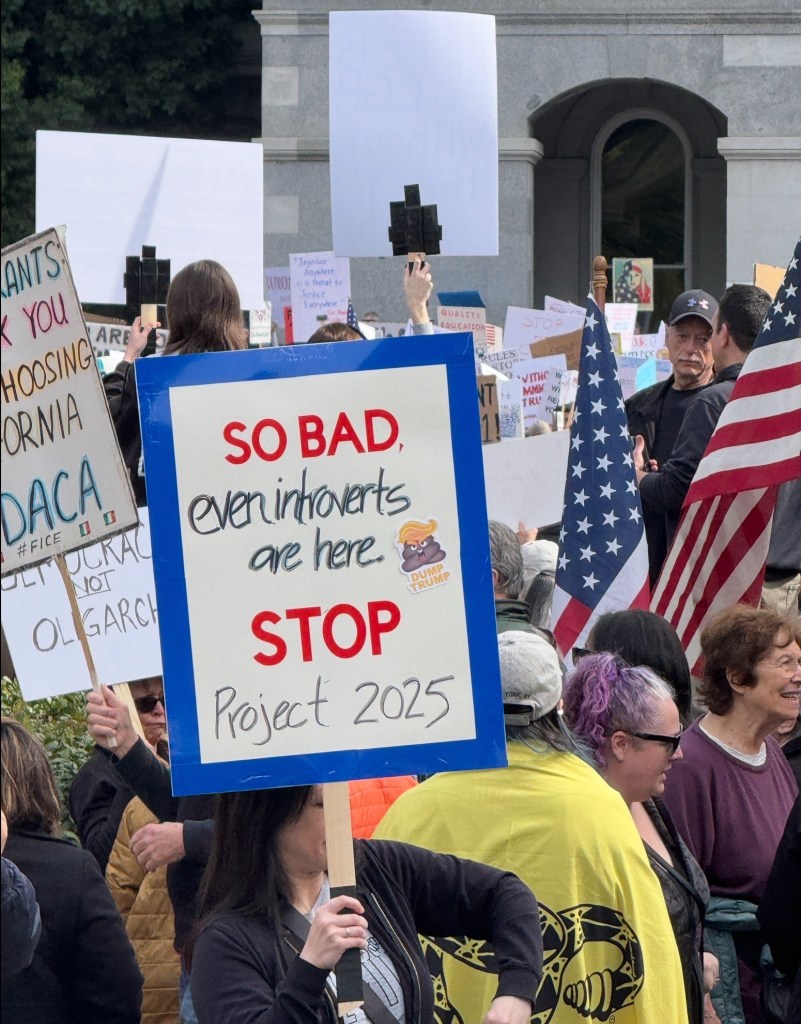
While America’s co-presidents are rapaciously dismantling the agencies and institutions that kept the country running smoothly, it’s hard to see a bright side of the current moment. Our executive branch has been inflicting abuse wherever their cruelty takes them, except on those who are as cruel as them, who get tax cuts. It’s hard not to believe that they’re working for someone else, and not us— us being the fabulously assorted unwealthy.
The sociopathic decision-making at the top makes the daily news bleak. However, there are days when the positive bits begin to stack up— court cases won by the defendants of freedom, former allies of the administration defecting, the consequences of sociopathy at the helm evident— and we think the fascists aren’t going to prevail after all. There was a day like that recently, when three disparate things added up to hope: what’s happening with government workers, Luigi Mangione’s first statement since his arrest, and news of an academic study about how things change.
First, the government is closing important agencies and firing career civil servants, whose expertise has made so many vital services possible, replacing them with yes-men. This naturally produced a lot of incendiary outrage from career civil servants suddenly without jobs, leaving important work in the hands of overworked survivors of the purge and dopes, if it’s done at all.
Every group of government workers has a union to ensure their rights, except the postal service, which can negotiate their own raises. Like so many things in this huge country, every variety of government worker has specialized expertise, and their unions represent their part. What happened over the last days is that for the first time in our history, the many unions representing government workers are uniting in a solid front. The government is the single largest employer in America, and that is a lot of collective rage from the civil service. Every union has seen a significant increase in membership, too. The resistance is gathering among the people who know how the government should work, and how to put it back together. We can never ignore the force of solidarity.
The second hint of hope was Luigi Mangione’s first statement to the public since his arrest:
“I am overwhelmed—and grateful for—everyone who has
written to share their stories and express their support.
Powerfully, this support has transcended political, racial,
, and even class divisions, as mail has flooded MDC from
across the country and around the globe.”
It’s believed that every letter sent regarding a specific topic represents the opinions of 10,000 people, and it is increasingly rare to write letters at all. If Luigi is getting a flood of supportive mail, you know that indicates an enormous amount of rage against corporate brutality, felt by people of every demographic. This is a potent sign of previously unrecognized solidarity.
The third bright spot: the work of Erica Chenoweth, a Harvard political scientist, clarifies the power of this accumulated outrage. Examining protests over the last century, she found that nonviolent protests are twice as likely to achieve goals as violent ones, and that it only takes 3.5% of a country’s population actively protesting to bring about change. The” 3.5% Rule” surprised even the academic who discovered it.
A quick look at some of the 3.5% Rule’s huge successes is cause for hope, even though they rarely, if ever, included the don of a protection racket owned by a foreign dictator (under the code name “Krasnov”) with a building full of hostile propagandists working to dismantle America. We’re currently facing big odds. But as the co-presidents destroy everything people rely on and threaten more of same, an increasingly large number of people are joining that significant percentage of collaborators we need to stop them.
Perhaps the most stunning case of the 3.5% Rule was the ousting of Ferdinand Marcos in the Philippines. Marcos and his infamous wife, Imelda, plundered the country’s wealth to finance their lavish lifestyle and ran the country with an iron fist, including martial law for 9 years. There were bombings and opposition forces that went on and on over the 31 years of his rule that didn’t deter him. What made Marcos finally flee was millions of people taking to the streets in peaceful opposition. Praying.
In the country of Georgia, in 2003, Shevardnadze’s corrupt Soviet style government left its people living in poverty, and opposition parties formed to get him out. It was speculated that Shevardnadze rigged the election and the reaction was huge. The young politician Mikhail Saakhashvili, dressed in jeans and a leather jacket, marched through the streets of Tbilisi with 100,000 supporters carrying roses, following Saakhashviii to the government building where Shevardnadze was speaking. He entered the chamber, armed with a rose, and called out the dictator on national television. Shevardnadze resigned the next day.
No one enjoys being enraged, but we must stop thinking of it as a cruel thing inflicted on helpless people who can’t stop it. Rage is, in fact, a tool that we can use to make things change. The collected fury of a nation is a powerful thing, and since the co-presidents and corporate oligarchs inspire it across all demographics—as love letters to Luigi show—we should easily be at the 3.5% mark in a single month of the current administration.
Be the Rose Revolution. Show up to support opposition, boycott companies that harm us and make billions, write letters. Think of our collective rage as a gift, a force that can make our society better for us all. Without rage, we’d be complaining on social media and enduring the four years of a stupid administration. Being enraged makes us do something to be proud of. Use that rage creatively, whenever possible.
As always, Proust gives us insight to cheer us in dark times:
“But political parties are like all the rest; they do not last.”
Good riddance, GOP.

 Proust Said That ©